
Most mornings I sit with my tea and say good morning to two Trees who anchor the land where I live: one is named Douglas Fir and the other is named Grand Fir. They feel like friends to me at this point after years of living nearby.
Douglas Fir is one of the iconic trees of the Pacific Northwest, with its thick gray fire-resistant bark and deep green needles. This Tree is actually a member of the Pine family (in the way we humans like to organize things) and its name is pseudotsuga meaning false hemlock. (Four years of high school Latin comes in handy more often than you’d think!)
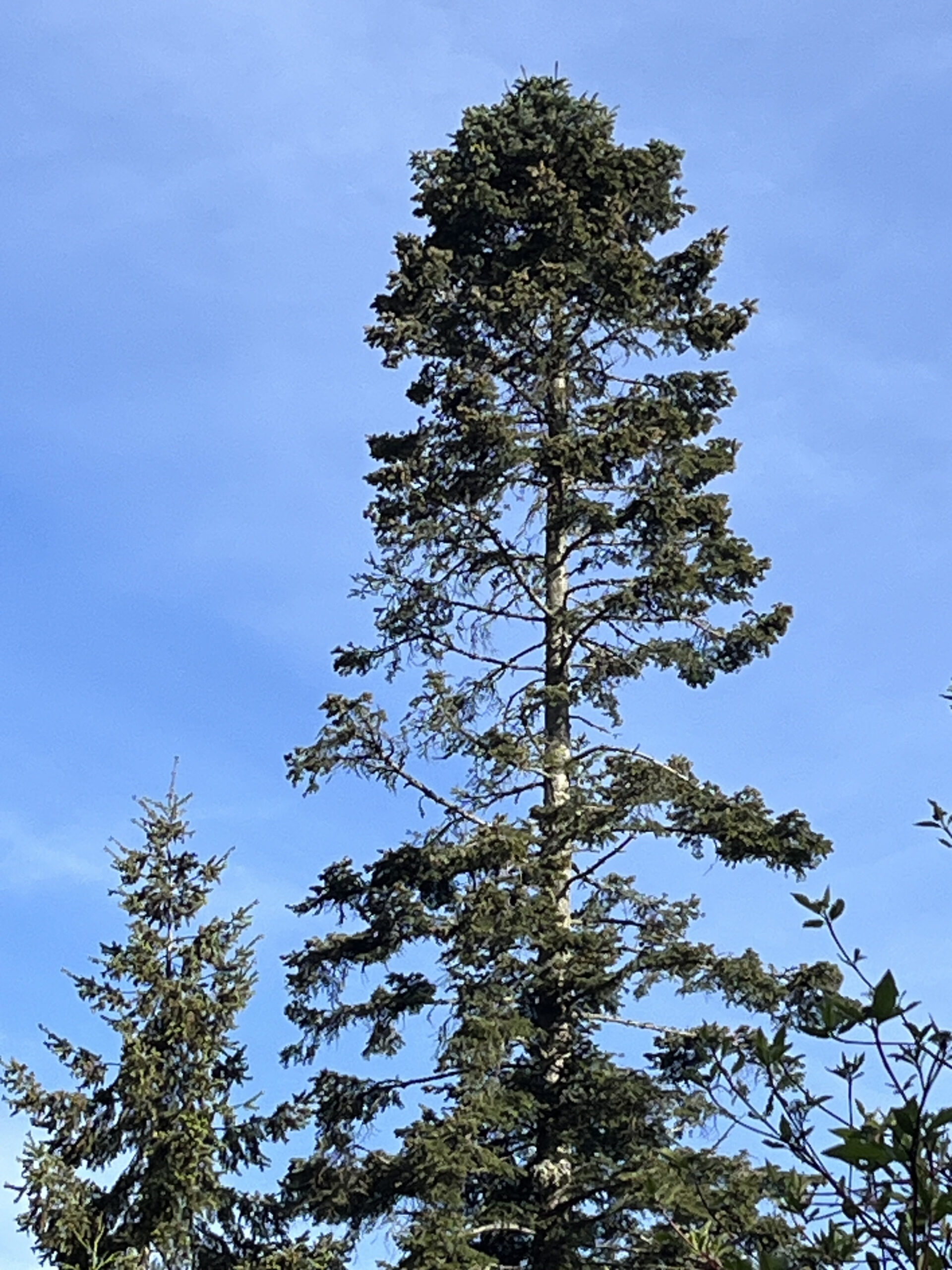
Looking from my porch or my sofa, I am more able to see the immensity, especially of Douglas Fir, than I am when I walk by or sit at the trunk. At the fluffy-looking top, there is a whole world! That is what strikes me the most, lately — a whole world up there that I know virtually nothing about, hosted by Doug Fir. Here are a few of the living beings who make their home or are frequent visitors in the upper canopy:
Mammals:
- Douglas Squirrels (Chickaree): Highly associated with these trees, they eat mature pollen cones, young needles, inner bark, and store seed cones for winter.
- Red Tree Voles: Lives almost exclusively in the canopy of Oregon old-growth Douglas Firs, feeding on needles and nesting in the branches.
- Northern Flying Squirrels: Nests in tree cavities and glides between branches.
- Townsend’s Chipmunks: Feeds on seeds and inhabits the forest floor and lower branches.
- Black-tailed Deer & Elk: Browse on the foliage and twigs.
- Black Bears: Known to eat the sap.
- Little Brown Bats: Roost in the thick, rugged bark or cavities of old trees.
Birds:
- Red-breasted Nuthatches: Abundant in the upper and mid-crown areas, particularly during spring.
- Red Crossbills: Almost exclusively limited to the upper canopy, where they use their specialized beaks to extract seeds from cones.
- Chestnut-backed Chickadees: Commonly found in the upper canopy, especially during autumn and winter.
- Golden-crowned Kinglets: Frequently forage in the upper branches. (love seeing these little guys!)
- Yellow-rumped Warblers (Audubon’s): Breed in high conifers and forage in the upper canopy.
- Western Tanagers: Often found in the open tops of Douglas firs in forest edges.
- Vaux’s Swifts: Forage high in the air above the canopy and nest in large hollow trees.
- Raptors (Bald Eagles, Red-tailed Hawks): Use the very top of high Douglas firs as perches to survey the landscape.
- American Crows: Known to build nests in the upper branches.
Insects:
- Douglas-fir Tussock Moth: Larvae feed on the needles.
- Douglas Fir Beetle: Common in older or weakened trees.
- Spiders: Abundant throughout the branch canopy.
The upper canopy is a high-energy area (41-60+ meters) characterized by intense sunlight, feeding these specialized “upper-canopy” species. It’s amazing to me that so much life goes on where I don’t really see it, can’t see it up close — and yet there it is! What else don’t I know???
I got a bit fascinated with the Red Tree Vole so here is a little more about this tiny creature who lives their whole life in the Trees:
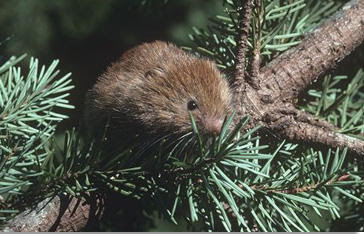
Red tree voles are found solely in Oregon. They live in coastal forests and along the western slope of the Cascade Mountains. Red tree voles, unlike most other voles, live in trees. Individual voles have very small ranges and tend to keep to the cover of one or a few trees. They prefer old, tall Douglas Fir trees, but are occasionally found in forests of Grand Fir, Sitka Spruce, and Western Hemlock. Red tree voles usually occupy the lower third of the tree crown, but nests have been discovered from 2 to 65 meters above the forest floor. They typically build their intricate nests on branches near to the trunks of trees, but some nests have been found in tree cavities as well. Nests have separate areas for feeding and using the bathroom, and there is also an escape route to the ground. They can only occupy forests with high levels of humidity and rainfall because they require the extra moisture to coat fir needles as their water source. Red tree voles avoid many ground-dwelling predators by taking to the trees. However, they still become dinner for Raccoons, Martens, Fishers, Raptors, and more commonly, the Northern Spotted Owl. (National Wildlife Federation)
If I could somehow climb all the way up this over 100′ tall Douglas Fir without giving in to my enormous fear of heights and without disturbing the creatures who make their home there, I would do it in a minute!
What is sounding in my heart this moment is that I wish to walk more gently in this world. There is so much I cannot see from my individual vantage point. May I err on the side of making space, allowing other life to flourish alongside my own. That is a gift of Douglas Fir and the worlds in their canopy today.
And now my tea is cold and I am late for other commitments, so I will send this on!
I am teaching Healing Touch this month, and taking an environmental ethics class, and my healing practice is fully booked til June at this point. If you are in need of a session, please reach out for June bookings. There will also be a new session of weekly distance group balancing starting again in June — let me know if you are interested and look for an email.
May You Live at Ease of Heart with Whatever Comes to You in Life.
From my Heart to your Heart, I wish you Love, Joy and the Peace that Passes Understanding.
LOVE
Elizabeth