
Greetings and Blessings this day!
I am reflecting on the Green of Winter, Plants who accompany us in these dark days, freely giving their fragrance, friendship and beauty. The Evergreen Trees of our Yuletide, of our Christmas, of Light Remaining and Returning. Grounded Light, Rooted in Evergreen. This email is an invitation to slow down and look again, exhale and breathe, and offer gratitude for what is so freely given.
Suggested soundtrack:
George Winston’s December (piano solos)
https://www.youtube.com/watch?v=TKzgKSqBIeY
Scroll to the bottom of the page for a fun and easy project: Making your own Infused Pine/Spruce/Fir/Cedar Oil!
(use a single species or more than one — use what you have.)
Pines, Firs, Spruces and Cedars are all conifers and can be distinguished by their characteristics including needles, barks, and cones. A quick way to distinguish: if a twig bears single needles, it is likely either (flat) Fir or (sharp) Spruce; if a twig bears needles in groups of 2, 3 or 5, it’s most likely Pine. Cedars are a little different, with mostly highly aromatic, short, flat needle clusters.
See?
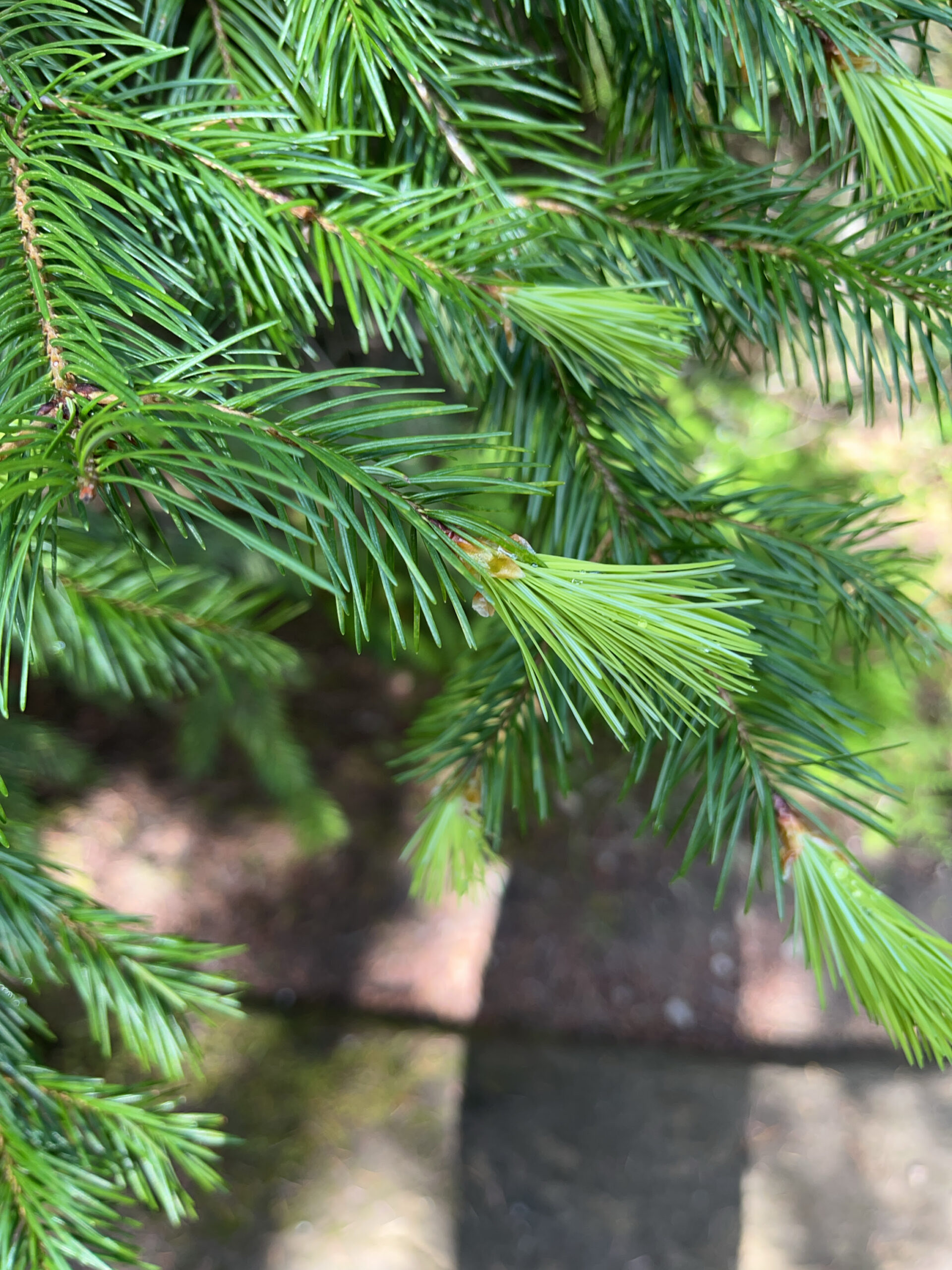
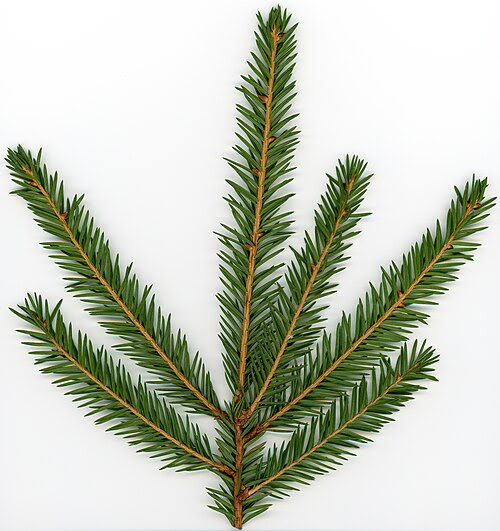
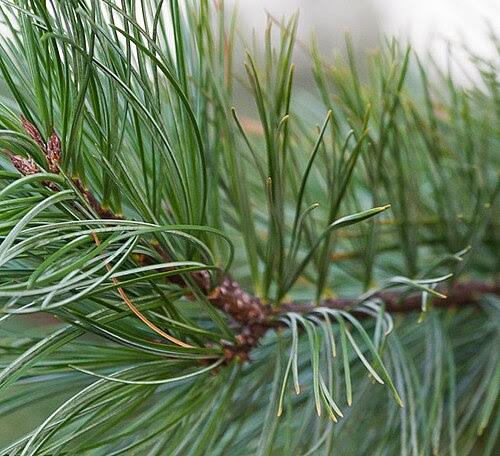
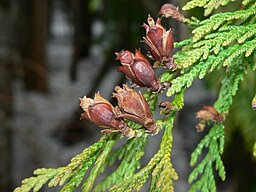
God, or the gods, are invisible, quite understandable.
But holiness is visible, entirely.
Pines, Spruces Firs and Cedars are all Conifers, appearing in the fossil records over 300 million years ago in the Carboniferous period and were dominant until deciduous trees took over in the Cretaceous. They are wind-pollinated — just sense into that, let the Air element speak to you.
We are focused on the generally pleasing scent and memory of evergreens here, though aromatherapeutic qualities can run the spectrum of emotions and memories. If you want to know more about the science of scent, here is a link to an article from the Cleveland Clinic: https://health.clevelandclinic.org/smells-and-memory .
The areas of our brains that process smell are responsible for memory and emotion. Scent is processed directly by the olfactory nerve, bypassing the relay center in our brains by which other sense inputs are processed. This links scent to our evolutionary history in a deep way — smell was one of our first senses to develop.
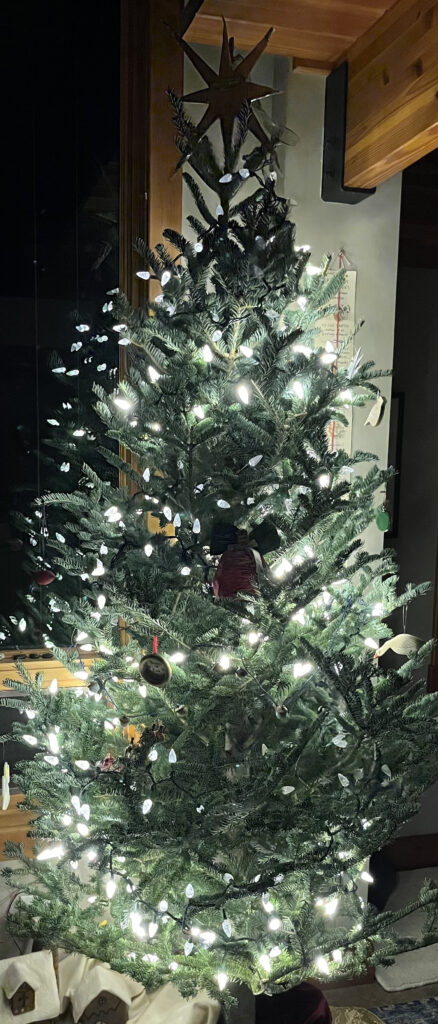
One of the most enjoyable and grounding aspects of this time of the year is the fragrance these boughs and branches bring to our homes. While no email can yet convey the fragrance, perhaps you have a Christmas tree or a swag or wreath that you can go to now, and breathe in and out with a bit.
All important ideas must include the trees,
the mountains, and the rivers.
All these Trees have metaphysical properties to teach us, if we are willing to take time and effort to reflect upon them. You might want to take another look at the photos above, or visit your yard or a nearby park and see how these Trees speak to you.

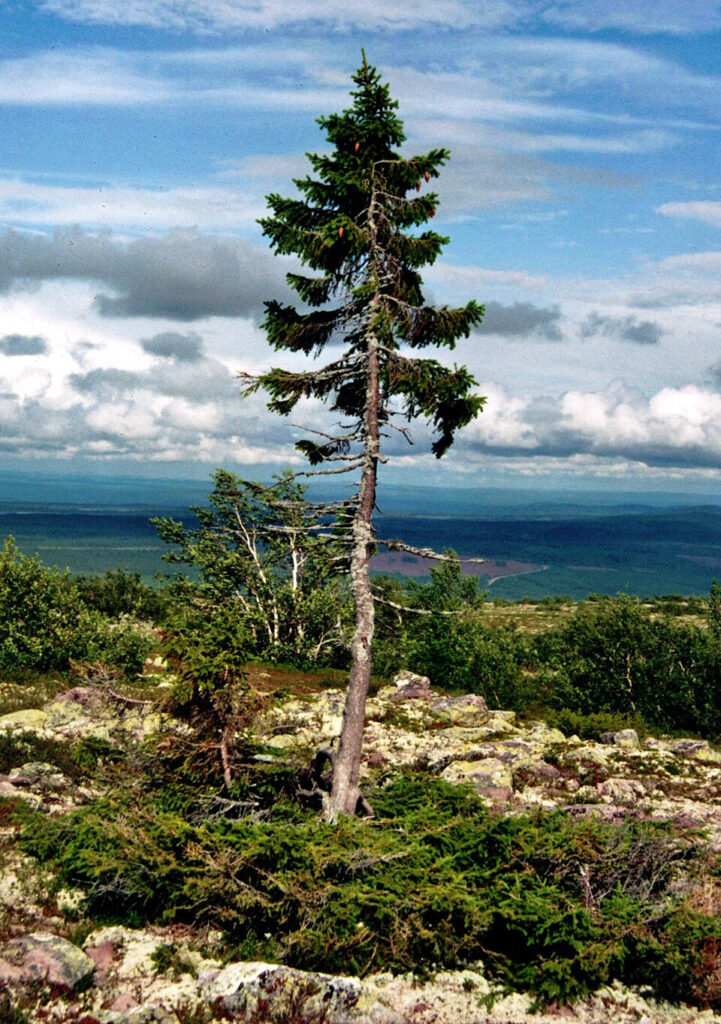
Through history, all Evergreens are associated across cultures with Immortality, Resilience, Strength, Wisdom and Hope. Evergreen. Even in the depths of Winter, when other Plants give up their leaves or die, Evergreen reminds that even in the darkness life moves on to spring forth again. To the Druids, the Fir meant Longevity, Protection and Good Fortune. Spruces are linked with Endurance and Longevity: see Old Tjikko, an approximately 9,568-year-old Norway Spruce in Sweden. Native American traditions link White Pine with Peace, the Iroquois Confederacy formed when 5 warring tribes buried their weapons beneath a large White Pine. Strength, Abundance, Generosity, and Divine Connection are qualities of Cedar.

Read more about that story here: https://indigenousvalues.org/haudenosaunee-values/great-tree-peace-skaehetsi%cb%80kona/

And here is a photo of Old Tjikko:
For how many years did I wander slowly
through the forest. What wonder and
glory I would have missed had I ever been
in a hurry!
Some history of our Evergreen Winter customs:
The use of the fir tree as a Christmas tree is usually attributed to Prince Albert when he introduced the tree as a Christmas staple in 1840. Though, to be fair, Queen Charlotte, wife of George III, actually set up the first known tree in 1761 in Windsor (Barnes 2006).
The 16th-century Protestant reformer Martin Luther is said to begin the practice of lighting candles and stringing them into the trees, to capture the image and feeling of awe he felt when he looked up at the twinkling stars in the sky. By 1605, there was a record of the people of Strasburg hanging roses, apples, gold foil, sweets and wafers from fir trees in their parlour (Barnes 2006). Beautiful, yes?
This tradition made its way to America in the early 1700s by German settlers in Pennsylvania. As late as the 1840s, however, most Americans viewed Christmas trees as pagan symbols and shunned them. Queen Victoria, who was popular with her subjects, helped change attitudes when she was depicted with Prince Albert and their children under a Christmas tree. This image popularized the tradition and made it into an acceptable fashion, even for those living in America. (see the article for the image: https://www.history.com/articles/history-of-christmas-trees
In northern Europe, people considered Fir Trees the king of the forest and were reluctant to cut them down since each Tree had a resident spirit. (At least ask permission first.) In the Harz region of Germany, people used to dance around a Fir Tree so the resident spirit would grant them favors (Harrington 2020: 59).
Pine Trees figure in Greek mythology: in one story, the god Pan and the north wind Boreas both loved the nymph Pitys. She preferred Pan, and in a jealous rage, Boreas blew her off a cliff. A pine tree popped up on the spot where she’d stood and became a sacred tree of Pan (Porteous 2002 [1928]).
And remember, the Heart Chakra is generally associated with the color Green.
Well, I have spent many hours putting this delightful information together and it is now time for a walk in the Trees.
It is my heartfelt hope that you have enjoyed reading this, and I thank you for spending some of your precious time with me in this way.
I wish you many blessings on your path, and many cozy moments amidst the fragrance of Evergreen.
May we all, you and I and everyone we love, be at ease of Heart with whatever comes to us in life.
LOVE Elizabeth
Some resources:
Baker, Margaret (2011 [1969]) Discovering the Folklore of Plants, 3rd edition, Oxford: Shire Classics.
Harrington, Christina Oakley (2020), The Treadwell’s Book of Plant Magic, London: Treadwells Books.
History Website. https://www.history.com/articles/history-of-christmas-trees
Oliver, Mary. Leaves and Blossoms Along the Way. (fragments of the poem embedded)
Porteous, Alexander (2002 [1928]), The Forest in Folklore and Mythology, Mineola, NY: Dover.

Easy and Fun Winter Day Project
Make a Fragrant Conifer-Infused Oil:
What you Need:
One Mason Jar of any size
Fresh Spruce, Fir and/or Pine needles
Extra Virgin Olive Oil
and that’s it!
Gather some fresh conifer branches (avoid Yew, it’s toxic — focus on Pine, Spruce and Fir).
Allow branches to dry off for a day.
Use scissors or a sharp knife to cut the twigs and needles into approx 1-inch pieces (or smaller if you desire). Pack them into a mason-type jar. (Choose a size that you can fill completely for best results.)
Pour extra virgin olive oil over the needles to cover them completely. (This is important.) The needles may pop up, tending to float or stick up, so just press them down as best you can.
Cover the jar tightly. Shake to completely soak all the needles in the oil.
Place in a cool dark location for 2-3 weeks, remembering to give the jar a good shake very few days.
Strain the conifer oil through a fine sieve, pressing to get all the yummy-smelling oil out of the needles. Rebottle the oil.
To process the oil faster, you can gently, ever-so-gently, warm the oil and needles together on the stovetop.
Use this warming oil for moisturizing winter-dry skin; it may also help with circulation and pain relief. (Always try a test patch first to make sure you don’t have an unexpected reaction to the oil.)
Make an herbal salve or lip balm by melting some beeswax into the infused oil.